
From the Front to the West Coast
Ilkka Uitto, Director of Photography, speech at the Scandinavian Centre April 26, 2026
Thank you all so much for being here today.
It really means a lot to see so many of you here.
We all have our own stories and reasons for how we came to Canada…
and for how we ended up sitting right here, in this room, today.
In my family’s case, our journey to Canada began in a very unlikely place:
on a bus in Dubai.
My father was riding that bus when he exchanged business cards with somebody who was at the same conference.
Two years later, that small moment turned into a phone call,
inviting him to Vancouver for a position that had opened at UBC.
Later that summer, he moved our entire family
from Helsinki to Vancouver.
Fast forward 24 years.
I’m working for Yle at the Paralympic Winter Games,
and—again, serendipitously—I meet Satu.
And yes… also on a bus!
Naturally, we exchanged business cards,
and that spring Satu reached out to me,
inviting me to a veterans’ meeting here at the centre
to do a test interview with Usko Arvonen.
That interview with Usko was something special.
He shared his memories of the war,
but also the sometimes humorous, very human stories
about the challenges he faced after the war.
Those accounts—moving, painful, and at times funny—
made this a very special conversation.
Over the next year, with the help of many people – we went on to interview the remaining 30 veterans.
They invited us into their homes.
And in true Finnish fashion,
we were almost always offered coffee and pulla.
The veterans had the courage to go back into memories
many of them had tried not to revisit for a long time.
There were long pauses.
There were tears.
There were moments when words just wouldn’t come.
Those visits brought me back to my own grandparents in Finland.
And I realized how many questions I never asked them
about their lives during that time.
I was fortunate to travel to Finland a couple of times
to shoot footage for the film,
collect archival material,
and gather maps of the areas the veterans spoke about.
One of the map books we used actually belonged to my great‑grandfather.
Satu had to handle it very carefully,
because it was literally coming apart at the seams.
We were also incredibly lucky
to receive personal photographs from the veterans themselves.
These images, and their words, really bring their stories to life.
Because of the sacrifices and bravery of these veterans all of us here have had the freedom
to choose our paths.
For these veterans, it was very different.
They were forced into war.
And then, for many of them,
they were forced into a very different kind of journey—
a voyage of discovery that, in many cases,
eventually brought them here, to Canada.
Making this documentary has been a privilege,
and a way for me to honour not only these veterans,
but also the generation my own grandparents belonged to.
I hope you will find their stories
as powerful and meaningful to listen to
as they were for me to help record. I hope you enjoy! —
________________________________________
From the Front to the West Coast premiered on Finnish Broadcasting Company’s Channel One!
Our film, From the Front to the West Coast, the Recollections of the Finnish War Veterans in Vancouver was shown on the Finnish Broadcasting Company’s Channel One on Thursday July 18th 2024 on prime time. It has been shown again, several times.
The film is also available to view on Yle Areena for three years, until July 15, 2027, but only in Finland.
The premiere was the culmination of our journey. It has been a long one for Satu, Ilkka and me, from the beginning of the project in 2010. The seed for the project was sown when I made a speech at Finland’s Independence Day Dinner in 2009. At that time, Finland was focused on the start of the Winter War, 70 years earlier. The first day of the Winter War, November 30th, 1939, had always held a special meaning for me. That was the day my grandmother lost her beloved brother, Antti Nikula. He was one of the first to respond when Russians crossed the border that fateful day, becoming the first officer to die in the Winter War. Even though they have been looking for him, and even decades later, he has never been found.
After my speech, a few months later in the spring of 2010, we were having a very enjoyable ski night, when Satu Bell came up with the idea that we should write a book about the Finnish war veterans in Vancouver. She was inspired by my great uncle’s story, and she wanted to know more about the local veterans. I had started working as the Manger at the Scandinavian Centre the previous year, and I didn’t think I would have time for such a project. But Satu kept on insisting that we needed to write the book, and that we needed to do it now. Time was running out; these were the last moments to hear the veterans’ stories. I agreed, and said I would write the book, on the condition that Satu would be the one interviewing the veterans. And not only that, I would also need to have the interviews on film, because I wanted to see the veterans’ faces to see what they were thinking about, and how they felt going back in time. Satu agreed to all this, wondering how she would find someone to shoot the veterans. But it didn’t take long before I got a call from Satu. She had found a Finnish cameraman, whom she had met during the Vancouver Olympics. That was an unbelievable coincidence. It was meant to be. Satu informed me that since we now had a cameraman, we would be doing a documentary film as well, and I would be the producer. “But Satu, I don’t know anything about producing a documentary film,” I protested. Satu replied: You’ll learn.”
The three of us started the project. Usually, the first thing you do is to get the funding in place. We didn’t have the time, we had to get going. We also had no idea how big a project we had taken on. Maybe that was a good thing, it was certainly daunting at times. But we had faith. We believed that with such a good cause, people would help us. And they did. Every time we asked for help, from anyone, the reply was: “When do you need it? Is there anything else I can help you with?” This is how we found our theme music composer, Mari Petznek. I knew Mari to be a very accomplished musician, and I asked her to compose the theme for our film on the war veterans. Mari was quite hesitant, asking in which language, and that she had not done something like this before. I replied, in a Satu-kind of way, that you can do this. In a few hours Mari phoned me that the piece, Näkemiin (Farewell) was ready.
We made plenty of mistakes as well. For example, when sending Mari to the studio to record the piece. Once I got the finished result, I realized that we had an excellent piece of music. There was only one problem, we needed an instrumental as well! I just hadn’t thought of that. I phoned Mari to thank her, and immediately asked her to go back to the studio to record an instrumental. “You’ve got to be kidding me!” exclaimed Mari. But in the next breath she asked what kind of a sound I wanted. I hadn’t ever even thought about that, let alone that I’d have options. But somehow the answer popped into my mind, and I replied that I wanted the sound of Kantele, the most Finnish of all instruments.
However, many things were done right. Later, when I was delving into music rights and licences, I found out that you must have your own theme music. You can’t borrow someone else’s.
On March 9, 2014, the film had its premiere at the Blueshore Financial Centre for the Performing Arts in North Vancouver. The hosts of the event were the Finnish War Veterans in British Columbia and the Vancouver Finlandia Club. The theatre was full, and we were overjoyed to have many of the veterans with their spouses in the audience. The film was exceedingly well received. On top of that, we were able to hand the veterans their own copies of the book, hot off the press. What a wonderful day that was!
Many thanks to our Finnish community here for all your help and support. Without the veterans we wouldn’t be here. The veterans welcomed Satu and Ilkka to their homes, and openly told us about their recollections: Usko Arvonen, Esko Saarinen, Mike Rautiainen, Ray Rinta, Pentti Parviainen, Sakari Kujansuu, Irja Rinta, Oiva Pohjola, Aate Rinkinen, Allan Hakkarainen, Eero Kajaan, Tauno Tirkkonen, Alvi Koverola, Pentti Kiuru, Elsa Lyly, Erkki Länsimäki, Kaija Kalevala, Kauko Hovi, Miriam Linnakallio Koskinen, Mirjam Kallio Horvath, Eino Kyynäräinen, Eino Niemelä, Niilo Hyytiäinen, Nils Karlström, Jaakko Noso, Helena Paljakka Fletcher, Nestori Koivumäki, Ray Payne, Martti Koivisto, Pauli Asikainen and Erkki Salminen. Thank you also for all your support.
Thank you Satu for the interviews and photography. But above all for your courage, vision, and creativity to expand our project to include a documentary film. We wanted the veterans to be the only ones to speak on the film, and Satu skilfully follows their lives from Finland’s Winter War to life in Canada. Satu also chose the music for the film. Satu and Ilkka spent countless hours editing the film, especially on how to connect the scenes. The films shot by the soldiers during the wars were of great help.
Satu also took a portrait of each veteran. Each veteran received a framed photograph of themselves.
Thank you Ilkka for joining us, taking care of the shooting, lighting and editing. Thank you for finding answers to all our technical questions. Ilkka shot many videos in Finland, and they were used all over the film, from the beginning to the end. Ilkka aged some of the films so that they looked like they were shot at wartime. In the end, Ilkka was the only one of the three of us to be able to tell the films apart from some of the actual Finnish army ones. Ilkka’s videos made the film come alive in a different level.
Thank you very much to our composer and lyricist Mari Petznek. Mari knew many of the veterans. Farewell is based on the interview of Sakari Kujansuu.
Thank you to our famous history expert Mika Kulju of my hometown Tornio. He helped us enormously with history, photographs and writing.
Thank you to Petra Kaksonen, who designed our logo and all the advertising.
Finnish Alfred Kordelin Foundation gave us our first grant: without the Kordelin Foundation we might not have been able to finish the film. Thank you for believing in us. Thank you to Stefan Wallin of the Finnish Ministry of Education and Culture. He replied to our messages from his holiday overseas.
To The Finnish War Veterans in British Columbia, thank you. Chair Esko Kajander did a tremendous job to help us. Sirpa Arvonen, thank you for organizing many of the events to support us. Petteri Mökkönen, Mirkku Arvonen, Saila Nenonen, Seppo Hakkarainen, Inkeri Koverola, Brian Kvist, Eila Kvist, Osmo Kvist, Liisa Kyynäräinen, Jim Noso, Helvi Pulkki, Pauli Juoksu, Marianne Juoksu, Lahja Sarava, thank you!
Thank you to Vancouver Finlandia Club and Finland Society. Thank you to the Finnish Institute of Migration, who published our book, with the excellent help of Ismo Söderling. Thank you to Finnish National Photo Archives of Defence Forces, especially to Tiina Tuukkanen and Päivi Vestola. Thank you to Finnish National Audiovisual Institute, especially to Head Archivist Tommi Partanen. And thank you to Elmo Helokumpu of Gramex. He assisted us even while he was on paternity leave!
Thank you to Finland House Society and Finnish Canadian Rest Home Society and its staff. Many thanks to Kristiina Oinonen for designing and maintaining our website.
Thank you to West Coast News, and the editor at the time of our project, Marja-Liisa Hassinen. Every month she would publish our ads and our stories. Thank you to the editors who followed, Marja Mattila and Elsa Marlowe.
Thank you to our budget and marketing advisor Mel Weisbaum. Thank you to our bookkeeper Riitta Huttunen, who also helped with all our transfers to Finland. Thank you to Jussi Lehtoranta who helped us in so many ways. Thank you to our references Jaakko Ihamuotila, Markku Seppä and Reijo Viitala.
Thank you Matt Bell, Marita Kareinen, Riitta Enridge, Marja Mattila, Kristiina Morrison, Kaija Rautiainen, Marja Riihijärvi, Don Staley, Helinä Clement, Mabel Eastwood, FinnTrade, Ulla Halbach, Marja Hammond, Harri Jansson, Eva Kangas, Anita Kapanen, Mark Kelly, Alec Kelly, Thomas Kelly, Dianne Kilback, Lea Koivumäki, David Laulainen, Karina Linder, Richard Lee, Eric & Lorene Mara, Liina & Leslie Marshall, Liisa O’Hara, Silvia Musto, Veikko Niemelä, Tom Nyberg, Timo Ikävalko, Veikko Pajunen, Peter Praegel, Mary Lou Reardon, Carina Spencer, Ron Stubbings, Ralph Sultan, Linnea Toikka, Irene Turner, FinnFun, Tuula Venäläinen and Riitta Wrede.
By the end of 2022, the world had changed dramatically. We approached the Finnish Broadcasting company again with our film. Once again, we had no idea how much still needed to be done. Our film, very tight at 66 minutes, had to be shortened to 58 minutes to fit the Finnish Broadcasting Company’s format. According to their directions we removed eight minutes, focussing more on life in Canada than wartime in Finland. Our sincere apologies to the veterans whose interviews we had to shorten or remove. Satu created a new vision of the film. However, it was Ilkka that had the biggest burden. He had to remove seconds in many different places, all the while keeping an eye on the continuity of the film, and music.
We still had the biggest hurdle to clear. Our liberal use of the wartime footage meant we owed thousands of euros to the Finnish National Audiovisual Institute. Our small remuneration wasn’t enough to pay even for the wartime footage, and there were still the music licenses to pay for, both rights to the music and to the performers. Once again, we asked for help from our Finnish societies. The Finnish Canadian Rest Home came through with a sum that covered the rest of the footage. Vancouver Finlandia Club, Pauli Juoksu and FinnFun helped to pay for the music licences.
At the Finnish Broadcasting company, we were helped by Ari Ylä-Anttila, Niina Tynkkynen and Jukka-Pekka Heiskanen. Thank you for your expert help. And when we had to remove the film’s subtitle translation of our Swedish speaking veteran, translators at the Finnish Broadcasting Company offered to make us a new, compatible one, without cost.
Thank you to everyone who helped and supported us. This has really been a community effort.
Rintamalta Länsirannikolle Ylen ykkösellä!
Filmimme Vancouverin suomalaisten sotaveteraanien muistelmista näytettiin Suomen yleisradion ykköskanavalla heinäkuun 18. Päivänä 2024 parhaaseen katseluaikaan. Filmi sai lisäksi vielä kolme uusintaa samalla viikolla, sekä myöhempiä näytöksiä.
Nyt filmi on nähtävissä Suomessa Yle Areenassa kolmen vuoden ajan, eli 15.7.2027 asti.
Matka projektin alusta vuonna 2010 tähän päivään on ollut pitkä. Projekti alkoi itää, kun vuonna 2009 pidin puheen Suomen itsenäisyyspäivän juhlissa Skandinavian keskuksessa. Kerroin talvisodan ensimmäisen päivän tapahtumista 30. marraskuuta 1939. Isoenoni Antti Nikulasta kaatui ja katosi tuona päivänä venäläisten tullessa rajan yli. Hän oli ensimmäinen talvisodassa kaatunut upseeri.
Muutamaa kuukautta myöhemmin keväällä 2010 vietimme oikein mukavaa hiihtoiltaa, kun Satu Bell totesi minulle, että meidän pitäisi saada lisää tietoa Vancouverin suomalaisten sotaveteraanien tarinoista. Joten – meidän pitäisi kirjoittaa kirja heistä! Olin aloittanut työt Skandinavian keskuksen toiminnanjohtajana edellisenä vuonna, enkä uskonut minulta liikenevän aikaa kirjan kirjoittamiseen. Mutta Satu intti, että kirja piti tehdä nyt, sillä käsillä oli viimeiset hetket haastatella veteraaneja. Myönsin, että näin on, ja asetin ehdoksi, että Satu haastattelee veteraanit. Sanoin myös, että halusin haastattelut filimillä, jotta näkisin mitä veteraanit haastattelun aikana ajattelevat ja tuntevat. Satu suostui, kylläkin ihmetellen, mistä hän kuvaajan löytäisi. Mutta ei mennyt kauaa, kun Satu jo soitti minulle ja kertoi löytäneensä kuvaajan, jonka oli tavannut Vancouverin olympialaisten aikana. Satu kertoi myös, että laajentaisimme projektin dokumenttifilmiksi, jonka minä tuottaisin. Protestoin, että en tiedä mitään dokumenttifilmin tuottamisesta, johon Satu: ”Sinä opit.”
Filmiprojektimme lähti siis liikkeelle kolmen ihmisen voimin. Meillä ei ollut aikaa hakea ensin edes rahoitusta. Emme ymmärtäneet kuinka iso projekti oli, ehkä oli hyvä, ettemme tienneet edessä olevan työn määrää. Luotimme siihen, että näin hyvälle asialle löytyy tukijoita. Ja näinhän siinä kävi. Joka kerta kun kysyimme apua keneltä tahansa, ja mehän kysyimme, saimme vastaukseksi: ”Koska tarvitset sen? Tarvitsetko mitään muuta?” Näin löytyi muun muassa tunnusmusiikkimme säveltäjä, Mari Petznek. Soitin Marille ja sanoin, että tarvitsen tunnusmusiikin dokumenttifilmiin sotaveteraaneista, ja voitko säveltää ja sanoittaa sen. Mari ihmetteli, että kummalla kielellä ja etteihän hän ole tehnyt tällaista ennen. Johon minä vastasin, Satua mukaillen, että kyllä sinä osaat. Parin tunnin päästä Mari soittikin minulle ja kertoi, että tunnusmusiikki, Näkemiin – kappale oli valmis.
Virheitäkin sattui, kuten kun lähetin Marin studioon äänittämään Näkemiin – kappaleen. Kuunnellessani lopputulosta ymmärsin, että kappale oli valtavan hieno, mutta että tarvitsisimme tietysti kappaleesta myös instrumentaaliversion, se ei vain ollut juolahtanut mieleen aikaisemmin. Soitin Marille, kiitin häntä ja heti perään ja pyysin häntä menemään uudelleen studioon äänittämään instrumentaalin. Mari ihmetteli, että nyt kyllä juksaat. Sopeutuvaisena ihmisenä Mari sitten kysyi, minkälaisen soundin haluan. Vastasin epäröimättä, että ilman muuta kantelesoundin.
Mutta joitakin asioita tehtiin myös oikein. Kuten kun myöhemmin selvittelin sekä Suomen että kansainvälisiä tekijänoikeuksia musiikkiin, kävi ilmi, että filmillä täytyy olla oma tunnusmusiikki. Sitä ei voi lainata!
Maaliskuun 9. päivänä 2014 filmi sai ensi-iltansa North Vancouverin Blueshore Financial Centre for the Performing Arts -teatterissa. Ensi-iltaa isännöivät Brittiläisen Kolumbian sotaveteraanit ja Vancouver Finlandia Klubi. Sali oli täynnä, ja iloksemme yleisössä oli monia veteraaneja puolisoineen. Filmi sai ihastuneen vastaanoton. Annoimme jokaiselle veteraanille myös kopion kirjastamme. Ne ehtivät nippa nappa Suomesta tilaisuuteen!
Suuret kiitokset koko suomalaiselle yhteisöllemme täällä kaikesta avusta ja tuesta. Suurin kiitos kuuluu tietysti itse Vancouverin suomalaisille sotaveteraaneille, jotka avasivat kotiensa ovet meille ja kertoivat sotamuistoistaan niin avoimesti. Ilman heitä tätä filmiä ei olisi olemassa: Usko Arvonen, Esko Saarinen, Mike Rautiainen, Ray Rinta, Pentti Parviainen, Sakari Kujansuu, Irja Rinta, Oiva Pohjola, Aate Rinkinen, Allan Hakkarainen, Eero Kajaan, Tauno Tirkkonen, Alvi Koverola, Pentti Kiuru, Elsa Lyly, Erkki Länsimäki, Kaija Kalevala, Kauko Hovi, Miriam Linnakallio Koskinen, Mirjam Kallio Horvath, Eino Kyynäräinen, Eino Niemelä, Niilo Hyytiäinen, Nils Karlström, Jaakko Noso, Helena Paljakka Fletcher, Nestori Koivumäki, Ray Payne, Martti Koivisto, Pauli Asikainen ja Erkki Salminen. Kiitos myös kaikesta tuesta.
Kiitos Satu haastatteluistasi ja valokuvauksestasi, ja ennen kaikkea uskalluksestasi, visiostasi ja luovuudestasi laajentaa projekti dokumenttifilmiksi. Halusimme, että veteraanit puhuvat itse, joten filmissä ei ole kertojaa. Satu kuljettaa tarinaa sujuvasti kohtauksesta toiseen, aina talvisodasta elämään Kanadassa. Satu myös valitsi musiikin. Satu ja Ilkka viettivät lukemattomia tunteja editoiden filmiä. Etenkin pähkäillen kuinka yhdistää kohtaus toiseen. Kavin arkistofilmeistä oli suurta apua.
Satu myös kuvasi jokaisen veteraanin, ja projektimme lahjoitti jokaiselle veteraanille kehystetyn muotokuvan.
Kiitos Ilkka, että lähdit projektiimme mukaan: kuvaamaan, valaisemaan, editoimaan ja löytämään vastauksia kaikkiin teknisiin kysymyksiin. Ilkka myös kuvasi monia filmejä Suomessa, jotka sitten sijoitettiin kerronnan lomaan. Monia luontokuvauksia Ilkka vanhensi näyttämään sota-aikaisilta. Viime kädessä vain Ilkka tiesi mitkä olivat hänen, ja mitkä Kansallisen Audiovisuaalisen Instituutin filmejä. Nämä kohtaukset elävöittivät filmiä suuresti.
Kiitos säveltäjällemme ja sanoittajallemme Mari Petznekille. Mari tunsi itse henkilökohtaisesti monia haastateltuja veteraaneja. Näkemiin pohjautuu edesmenneen Sakari Kujansuun haastatteluun.
Kiitos kotikaupunkini kuuluisalle historia-asiantuntijalle eli torniolaiselle Mika Kuljulle kaikesta avusta historian, valokuvien ja kirjoittamisen suhteen.
Kiitos logomme ja kaikkien mainostemme suunnittelijalle taitavalle Petra Kaksoselle.
Alfred Kordelinin säätiö oli ensimmäinen tukijamme: ilman Kordelinin säätiötä projektimme olisi voinut jäädä kesken. Kiitos, että uskoitte meihin. Opetus- ja kulttuuriministeriö ja ministeri Stefan Wallin, joka vastasi viestiimme lomaltaan Thaimaasta, kiitos.
Kiitos Brittiläisen Kolumbian suomalaisille sotaveteraaneille. Puheenjohtaja Esko Kajander auttoi meitä suunnattomasti. Sirpa Arvonen, kiitos kun järjestit monia tapahtumia projektimme tueksi. Petteri Mökkönen, Mirkku Arvonen, Saila Nenonen, Seppo Hakkarainen, Inkeri Koverola, Brian Kvist, Eila Kvist, Osmo Kvist, Liisa Kyynäräinen, Jim Noso, Helvi Pulkki, Pauli Juoksu, Marianne Juoksu, Lahja Sarava, kiitos!
Kiitokset Vancouverin Finlandia Klubille sekä Suomi-Seuralle. Kiitos Siirtolaisuusinstituutille, joka kustansi kirjamme Ismo Söderlingin valtavalla tuella. Kiitokset Puolustusvoimien Kuvakeskukselle ja etenkin Tiina Tuukkaselle ja Päivi Vestolalle. Kiitokset Kaville, Kansalliselle audiovisuaaliselle instituutille, etenkin vastaavalle arkistonhoitajalle Tommi Partaselle. Kiitos Gramexin Elmo Helokummulle, joka auttoi meitä isyyslomallaankin!
Kiitos Finland House Societylle, Vancouverin Suomalaiskanadalaiselle Lepokotiyhdistykselle ja sen henkilökunnalle. Kiitos Kristiina Oinoselle verkkosivuista ja niiden ylläpidosta.
Kiitos Länsirannikon uutisille ja projektimme aikaiselle toimittajalle Marja-Liisa Hassiselle, joka kuukaudesta ja vuodesta toiseen julkaisi ilmoituksiamme ja tarinoitamme. Kiitos myös häntä seuranneille toimittajille, eli Marja Mattilalle ja Elsa Marlow’lle.
Kiitos budjetti- ja markkinointineuvonantajallemme Mel Weisbaumille. Kiitos kirjanpitäjällemme Riitta Huttuselle, joka myös auttoi maksujen lähetyksessä Suomeen. Kiitos Jussi Lehtorannalle, joka avusti meitä monin tavoin. Kiitos suosittelijoillemme Jaakko Ihamuotilalle, Markku Sepälle ja Reijo Viitalalle.
Kiitos Matt Bell, Marita Kareinen, Riitta Enridge, Marja Mattila, Kristiina Morrison, Kaija Rautiainen, Marja Riihijärvi, Don Staley, Helinä Clement, Mabel Eastwood, FinnTrade, Ulla Halbach, Marja Hammond, Harri Jansson, Eva Kangas, Anita Kapanen, Mark Kelly, Alec Kelly, Thomas Kelly, Dianne Kilback, Lea Koivumäki, David Laulainen, Karina Linder, Richard Lee, Eric & Lorene Mara, Liina & Leslie Marshall, Liisa O’Hara, Silvia Musto, Veikko Niemelä, Tom Nyberg, Timo Ikävalko, Veikko Pajunen, Peter Praegel, Mary Lou Reardon, Carina Spencer, Ron Stubbings, Ralph Sultan, Linnea Toikka, Irene Turner, Vancouverin Suomi-koulu, Tuula Venäläinen ja Riitta Wrede.
Lähestyimme Yleisradiota muuttuneessa maailman tilanteessa eli vuoden 2022 lopussa tarjotaksemme filmiämme uudelleen. Emme taaskaan ymmärtäneet, kuinka paljon työtä oli vielä edessä. Filmimme, joka oli jo alun perin hyvin tiivis, piti lyhentää 66 minuutista 58 minuuttiin, jotta se sopisi Ylen formaattiin. Ylen toivomusten mukaisesti poistimme siis kahdeksan minuuttia, keskittyen enemmän elämään Kanadassa kuin sotiin Suomessa. Pahoittelumme veteraaneille, joiden osuutta olemme joutuneet lyhentämään tai poistamaan kokonaan. Satu visioi filmin uudelleen, ja Ilkka joutui tässä koville. Ilkan täytyi poistaa sekunteja eri paikoista, pitäen koko ajan silmällä jatkumoa kuten musiikkia.
Suurimman esteen kohtasimme, kun ymmärsimme, kuinka paljon joutuisimme maksamaan Kaville, eli Kansalliselle audiovisuaaliselle instituutille Suomessa sota-ajan filmien korvauksista. Meidän oma pieni palkkiomme ei riittänyt edes Kavin korvauksiin, saati sitten Teoston ja Gramexin musiikin oikeuksiin. Pyysimme jälleen apua suomalaisilta yhteisöiltä. Lepokoti kunnioitti veteraanien muistoa summalla, joka kattoi loput Kavin korvauksista, ja Vancouver Finlandia Klubi, Pauli Juoksu ja Finn Fun auttoivat musiikin oikeuksissa.
Yleisradiolla meitä auttoivat Ari Ylä-Anttila, Niina Tynkkynen ja Jukka-Pekka Heiskanen. Kiitos teille asiantuntevasta avusta. Ja kun jouduimme poistamaan filmistä suomenruotsalaisen veteraanin alkuperäisen suomennoksen, Ylen kääntäjät tarjoutuivat tekemään uuden, televisioon sopivan tekstin.
Kiitokset kaikille, jotka ovat meitä auttaneet ja tukeneet tällä pitkällä matkalla.
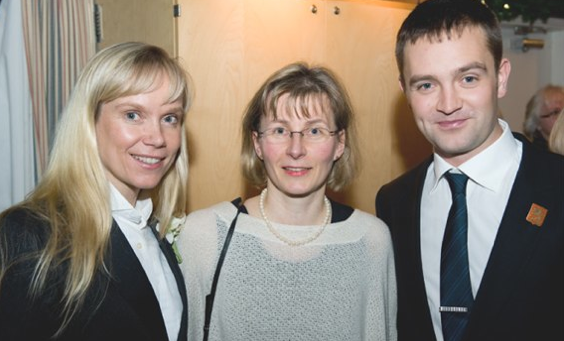
The Filmmakers (From left to right)
SATU BELL: Director & Producer
Satu Bell has 20 years experience in photography and post production. Satu attended the Photography Media and Darkroom Technician credits program
at the British Columbia Institute of Technology, and graduated from Langara College with honours, and a Diploma in Professional Photography. She has been working for 10 years as a still photographer for several Canadian and American feature films and TV series, and she is a member of International Photographers Guild. With the desire to direct her own film, she returned to Langara College to study the director’s role in film making. Satu has an innate ability at finding the true essence of her subjects, and capturing it on film. This talent is obvious and abundant in her directorial debut, From the Front
to the West Coast.
LEENA KELLY: Writer, Translator & Executive Producer
Leena holds an MA from Oulu University, Finland. She has been immersed in the field of language and communications as a language teacher, writer and translator. She is currently the Manager of the Scandinavian Community Centre in Burnaby, British Columbia, where she is also the librarian for the Vancouver Finlandia Club. The story of Leena’s great-uncle, the first officer to die in the Winter War, has served as an inspiration for the project.
ILKKA UITTO: Camera Technician & Editor
Ilkka holds Broadcast and Media Communications, Television Full-time Diploma from BCIT, Vancouver, Canada. He has also attended full and
part time Broadcast and film industry studies in Canada and Finland.
Ilkka has worked for the Finnish Broadcasting Company, David Suzuki Foundation and CBC Radio-Canada, Vancouver, among others. He has experience as a Camera Technician, Editor and Production Assistant. He is currently working full time in a visual effects studio in Vancouver. Ilkka is passionate about Finnish culture. His interests include videography and the visual arts, all technical aspects of video and audio production, documentaries, all year round sports, community and sustainable living.
ansiomerkki
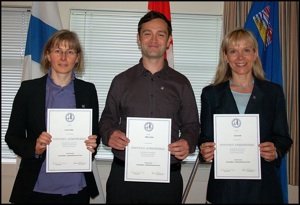
In April 2013, at the 40th Anniversary Celebration of the Finnish War Veterans in British Columbia, Leena Kelly, Ilkka Uitto and Satu Bell receive the Silver Achievement Pin for their work to preserve the stories of the war veterans.
In 2014 they received Finnish War Veterans Medals of Merit (Suomen sotaveteraanien ansiomitalit)